
Ever been stood up one too many times by a friend or a date? Feel like they’re just not getting the message that your needs aren’t being met?
This regrettably summarizes the experience of travelling aboard VIA Rail in Northern Ontario.
Between closed stations, chronically late trains and nearly no integration with local or regional transit providers, rail service in this region has become broken and dysfunctional.
Recently on one of my return trips home from Thunder Bay, my partner and I drove three and a half hours ― some 300 km ― to the nearest station (Longlac) so that I could catch the train.
We do this because neither the Canadian nor the Sudbury-White River trains directly serve this rail-accessible city of 108,000 ― the largest in the northwest. There are also no practical rail-bus connections.
Scheduled for 14:11, we ended up waiting five hours for its eventual arrival. At one point, I recommended that my girlfriend drive back home before it got dark.
The indoor waiting facilities at Longlac have been closed for more than a decade. The signage, long faded.
There are no washrooms or benches to speak of. Instead, ticket holders wait outside; exposed to the elements and sounds of mosquitoes buzzing, while sitting on concrete slabs.


The Canadian’s on-time performance didn’t improve once I finally boarded. Engineers eventually ran out of hours they could legally work just before Hornepayne, so passengers waited another hour for the arrival of a replacement crew.
The delays ― usually freight train related ― aren’t necessarily VIA’s fault. The company, unlike its American counterpart Amtrak, doesn’t have priority on railway tracks it doesn’t own.
However, VIA no longer compensates remote service passengers with travel credits in the event of significant delays. They are offered exclusively to passengers within the Québec-Windsor corridor.
These days, the Canadian’s “schedule” should be considered as a suggestion rather than a reliable timetable. Real world travellers can’t depend on it to arrive on time.
These issues were supposed to be resolved when the train’s schedule was lengthened in 2008, again in 2018, and when the frequency was reduced from three to two days a week.
| Westbound Timetable | 1998 | 2008 | 2018 / Today |
|---|---|---|---|
| Toronto | DAY 1 11:00 | DAY 1 22:00 | DAY 1 09:55 |
| Capreol | DAY 1 18:50 19:05 | DAY 2 05:38 06:08 | DAY 1 17:22 17:52 |
| Sioux Lookout | DAY 2 10:24 10:39 | 23:39 DAY 3 00:09 | DAY 2 11:25 11:55 |
| Winnipeg | DAY 2 17:00 18:00 | DAY 3 07:00 12:00 | DAY 2 19:30 21:30 |
| Western Canada | DAY 3 | DAY 4 | DAYS 3-4 |
| Vancouver | DAY 4 08:55 | DAY 5 09:42 | DAY 5 08:00 |
| Total Duration : | *72 hrs 55 mins | *86 hrs 42 mins | *97 hrs 05 mins |
| Eastbound Timetable | 1998 | 2008 | 2018 / Today |
|---|---|---|---|
| Vancouver | DAY 1 19:00 | DAY 1 20:30 | DAY 1 15:00 |
| Western Canada | DAY 2 | DAY 2 | DAY 2 |
| Winnipeg | DAY 3 12:50 13:50 | DAY 3 20:30 23:30 | DAY 3 22:00 23:30 |
| Sioux Lookout | DAY 3 20:14 20:29 | DAY 4 05:45 06:05 | DAY 4 06:01 06:51 |
| Capreol | DAY 4 13:55 14:10 | DAY 5 01:20 01:50 | DAY 5 03:47 04:27 |
| Toronto | DAY 4 21:35 | DAY 5 09:30 | DAY 5 14:29 |
| Total Duration : | *71 hrs 35 mins | *82 hrs 00 mins | *92 hrs 29 mins |
Federal Transport Minister (Pablo) Rodriguez, we need to talk.
VIA Rail may very well be an independent Crown Corporation, but this is no way to operate a public transportation service.
A report co-produced by Metrolinx and Ontario Northland demonstrates a genuine need for alternatives to road-based travel in the region. The province acknowledges:
- Intercity bus, rail and air services are limited
- Highway 11 north of North Bay is susceptible to road closures, with few, if any, alternative routes available for detours
- Air service in the North has reduced greatly and may never return to pre-COVID service levels
- A passenger rail service would provide significant value
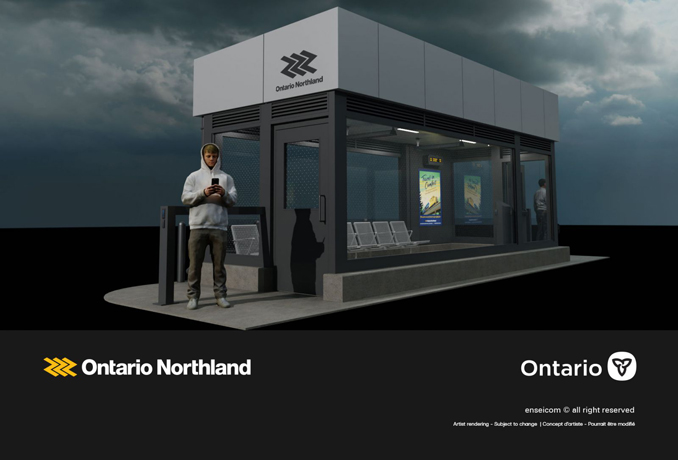
Ontario intends to reinstate the Northlander train by 2026. An order for new rolling stock has been placed, and accessible, climate controlled shelters ― equipped with Wi-Fi ― will be constructed in small and mid-sized communities on route.


The Government of Canada says it’s replacing VIA’s long distance fleet beginning in 2030. However, none of the aforementioned issues raised in this column have been addressed.
Travel in Northern Ontario remains difficult and can be prohibitively expensive ― as evidenced by the athletes who withdrew from the Ontario Winter Games in Thunder Bay due to the high cost of air travel.
It seems disingenuous for VIA Rail to solicit questions, only to avoid answering ones specific to the North during their annual public meeting.
The Government of Ontario identified Northern Ontario as a region underserved by public transportation with limited alternatives, and highways regularly closed due to collisions or weather related incidents.
As per the Northeastern Passenger Rail Service Updated Initial Business Case document, the province is restoring the Northlander, has purchased new train sets and is constructing station shelters to serve passengers in small and midsized towns along the route.
VIA Rail services in Northern Ontario remain difficult to access.
● Waiting facilities in most communities (e.g. Longlac) are locked up, exposing passengers to the elements.
● The Sudbury-White River train terminates in a village of 550 instead of Thunder Bay (population 108,000) further up the railway.
● No shuttle service provided by VIA connects passengers between Sudbury & Sudbury Junction stations, despite the existence of one between Québec City and Ste-Foy.
Why doesn’t VIA Rail Canada reopen closed station shelters (or build new ones), extend its White River train to Thunder Bay and provide a connecting link between the two Sudbury stations?
SUBMITTED : JULY 5, 2024
Much like when the Harper regime cancelled the Algoma Central service, federal policies are drafted with little consideration of the travelling public.
Canadian passenger rail has good qualities: affordability, comfort, space for legs and luggage, and friendly staff eager to make train travel a pleasant experience.
The act of connecting Northerners between smaller towns to larger cities ― like Thunder Bay ― shouldn’t be so complicated.
The Trudeau government is missing the mark, and can do better.


Discover more from Northern Tracks Blog
Subscribe to get the latest posts sent to your email.

This is about the same situation that existed in Northern Ontario in the 1960’s when my Mom and I took a bus to Longlac to board CN’s Super Continental. But at least, we could have boarded the Canadian in Thunder Bay if we had chosen CP Rail. The later political decision to give VIA traffic exclusively to CN was stupid and has been a disaster. For hundreds of miles, there is next to no possible passenger business for VIA in Northern Ontario, plus the spectacular scenery along CPs Lake Superior shoreline route has been eliminated.
LikeLike
If you want change, write to your MP, to the Minister of Transport, to the PM. Reality is the public abandoned the rails – enmase – and continue to favour private vehicles. And the Governments, through fuel taxes, will lose revenue if the public drives less and/or starts to use public transport ( of any type). All Governments have a conflict of interest. And of course the rails in North America are for profit corporations responsible to their shareholders: example hello Bill Gates, CN’s largest shareholder. Perhaps start a campaign to contact the larger shareholders as let’s face it the Canadian railways do have the public to thank for their wealth, all those free land grants and forgiven loans through the 1800’s. So the rails do have moral responsible to the Canadian public.
sd
LikeLiked by 1 person
Ha! I sure recognize that locked door at Longlac. Waited there a couple hours, even after using the tracking app to know not to go to the station “on-time”. Then the tracking time changed once I got there. Cold slabs, indeed.
Thanks for your publishing of these facts.
LikeLiked by 1 person